
Argo Space's Navigator Probe Fails to Test Water Propulsion After Solar Array Glitch
A partial deployment issue on the company's first orbital demonstration prevented engineers from validating the propulsion system that relies on water as fuel, coolant, and shield.
By Amelia Foster ·
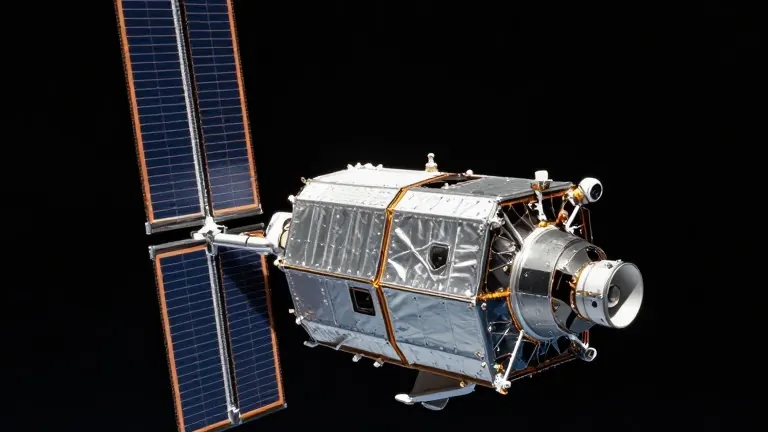
The Navigator spacecraft, Argo Space's first orbital demonstration, is currently in a power-negative state following the failure of one of its two rollout solar arrays. This technical fault has prevented the engineering team from executing primary tests on the vehicle's propulsion and power systems. The spacecraft launched in July 2026 on a Falcon 9 rideshare mission. Controllers successfully established communication with the craft after deployment. However, the single functional array was insufficient to generate the power required for the planned experiments. As a result, the spacecraft is draining its battery reserves rather than recharging them.
Argo Space was founded in late 2022 by Robert Carlisle, Ryan Carlisle, and Kirby Carlisle. The three brothers previously worked at SpaceX during the Falcon 9 era, where they were involved in launching, refurbishing, and selling rockets. Upon leaving SpaceX, the trio chose to focus their new venture on spacecraft design rather than launch vehicles. The company's core mission is to build infrastructure in space that reduces dependence on propellants sourced from Earth. Instead, Argo Space utilizes water as its primary propulsion medium. Water is abundant throughout the Solar System and can potentially be harvested on the Moon, making it a strategic resource for future operations.
Robert Carlisle stated that the company was based on water. This resource serves multiple functions within the vehicle design. It acts as a coolant for the thrusters and avionics and provides radiation shielding for the spacecraft. By using water for these systems, the company aims to increase the propellant mass fraction of its vehicles. A higher mass fraction allows the spacecraft to travel farther and perform a wider variety of tasks. The long-term strategy involves creating a transportation network that connects low-Earth orbit, geostationary orbit, and the Moon.
The Navigator mission was designed to validate the company's propulsion and power systems in a real orbital environment. The team spent approximately half a day troubleshooting the solar array issue and gathering data to assess the overall health of the spacecraft. Despite these efforts, the energy deficit persisted. This prevented the team from testing the propulsion system, which was a primary objective of the demonstration. The incident provides data for the company's development roadmap. The team is now analyzing the solar array failure to inform future designs.
Robert Carlisle noted that the water-based approach offers a commercial incentive for future operations. He stated that in the long run, this transportation model provides a profit motive to harvest water from the Moon's shallower gravity well. This economic driver supports the goal of sustainable space exploration by reducing the cost of moving assets between different orbital regimes and celestial bodies. Argo Space aims to unlock affordable logistics capabilities, including satellite resupply, refueling, repair services, and redeployments. The company remains committed to its water-based propulsion model as a key enabler for the next generation of space infrastructure.
The space industry is shifting its focus from simply reaching orbit to operating sustainably within it. Argo Space's approach treats in-space resources as integral to mission success. The success of future missions will depend on overcoming the technical hurdles identified during the Navigator test. The company must prove the viability of water as a universal propellant. The next phase of development will incorporate the lessons learned from the solar array deployment failure.
Source: Ars Technica
More Tech · National news · Report a business · Got a Story?