Breaking: Strategists Warn of Turbulence After Market Capitulation
Analysts describe the sell-off as a capitulation event but predict a eventual recovery based on historical patterns of Nasdaq corrections.
By Amelia Foster ·
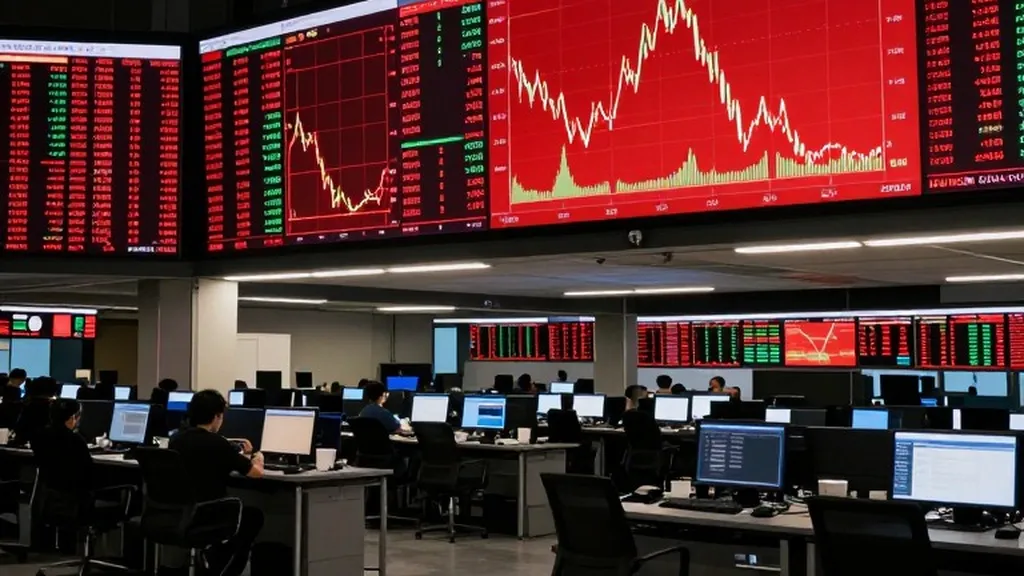
Wall Street strategists are describing Thursday's market crash as a moment of capitulation, a term that signals a sudden and decisive shift in investor sentiment. Neil Wilson, an investor strategist at Saxo UK, stated that a complete capitulation-level event was playing out in technology stocks. He noted that the fear is a total momentum unwind as Democrats pace the frontier and kibosh datacenter buildout. Wilson added that while the move looks totally overdone, the nature of sell everything in this market means investors need to look for some stability first.
The political landscape is now a primary driver of market sentiment. Dan Ives, a tech analyst, said there is no way to sugarcoat that Democrats taking control, especially over the Senate, will create some major hurdles for AI and tech legislation in the Beltway over the next two years. He emphasized that the midterm results are a clear sign the pace of data center build-out will start to slow. This legislative friction adds to the immediate financial shock felt by investors.
The economic narrative is also shifting from optimism to scrutiny. Ted Parkhill, founder and chief executive of Incline Investment Management, explained that the market is moving from the promise of AI to the price of AI. He acknowledged that AI is going to be transformative for the world in the long run, but he noted that does not mean every AI-related stock is currently priced appropriately. Parkhill warned that there is going to be a lot of turmoil as this adjustment process continues.
Despite the immediate panic, some leaders see a path to recovery. Gene Goldman, chief investment officer at Cetera Financial Group, said the sell-off had become exaggerated as selling accelerated through the day. He predicted a recovery, noting that when you have a correction in a bull market they are typically short lived. Goldman stated that it is ugly right now but we do think we will see a bounce back soon. This perspective offers a counterweight to the more immediate fears expressed by other analysts.
Historical data provides context for how such corrections often resolve. CNBC reviewed ten Nasdaq corrections over the last decade to understand typical outcomes. Sell-offs in 2025, 2022, 2020 and 2018 were followed by further rough selling over the next month. However, the Nasdaq was back in rally mode six months later in every case except 2022. On average, the Nasdaq gained 9.41 percent in the three months after a correction bottom and 17.03 percent over six months.
The January 2022 correction serves as the notable exception to this historical pattern. During that period, the Nasdaq lost another 18.3 percent over the next six months and was down 24.3 percent a year later. This outlier case reminds investors that while recoveries are common, the path can be volatile and not always linear. Frank Cappelleri, founder of CappThesis, noted that the Nasdaq was higher 12 months after the election in all but one of 13 midterm cycles since 1974, but the caveat is that the path can be a volatile one.
For local readers, these national trends have direct implications for personal finances. A day like this means that retirement accounts, which are often heavily invested in broad market index funds, will show significant losses on paper. Savers and small investors who hold technology stocks may see the value of their holdings drop sharply. The volatility affects the timing of withdrawals and the potential for short term gains or losses in these accounts.
The broader market context includes a sharp drop in major indices. The S&P 500 fell 4.3 percent, marking its worst day since April 2025. The Nasdaq Composite fell 5.5 percent, its worst day in 18 months. An estimated $2.5 trillion in market value was wiped from the Nasdaq Composite. These figures illustrate the scale of the financial adjustment currently underway across the United States.
The fear gauge, known as the VIX, jumped to above 28, its highest reading since March 31, 2026. This spike indicates heightened anxiety among traders. The 10-year Treasury yield fell to 4.83 percent as investors bought bonds as a haven. This move reflects a broader desire for safety amid the equity market turmoil. The interplay between stocks and bonds provides a snapshot of the current risk appetite in the financial system.
Source: BBC News, The Guardian with Reuters, The New York Times, CNBC
More Business · Bad Service · Report a business · Got a Story?