Rural Energy Costs: Two Alaska Governor Candidates Outline Their Plans
Candidates Kreiss-Tomkins and Bronson discussed the state's role in lowering rural energy bills at the Alaska Rural Energy Conference.
By Amelia Foster ·
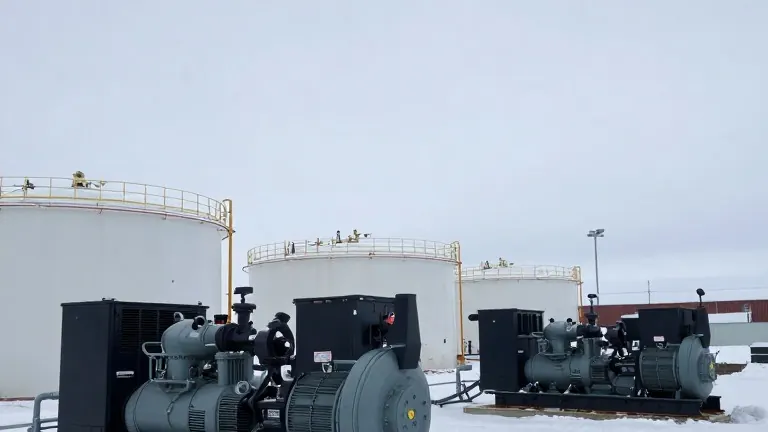
Residents in rural Alaska communities paying $15 to $26 a gallon for heating fuel heard two plans for lowering those costs Thursday. Jonathan Kreiss-Tomkins, a Democrat, and Republican Dave Bronson, a former Anchorage mayor, appeared on the final panel of the Alaska Rural Energy Conference in Fairbanks. The other two candidates for governor, Republicans Treg Taylor and Bernadette Wilson, did not attend.
Kreiss-Tomkins said the state's first priority is keeping electricity reliable and affordable in rural areas. He said he would veto any legislative effort to use the Power Cost Equalization program's endowment for other purposes. He also supports a statewide energy bond to help communities move off diesel. Bronson pointed to maintenance backlogs on existing equipment, citing nearly $300 million in deferred work on older diesel generators and about $1 billion for fuel storage. He proposed buying fuel in bulk for rural users and building a 400-mile ice road along the Yukon River to truck fuel during winter, calling it safer and cheaper than barging from the Lower 48.
Both candidates back the Power Cost Equalization program, which lowers electricity bills in rural areas. Bronson would forward-fund the program and pursue federal money for it, while saying it cannot substitute for building new power generation and fuel storage. Kreiss-Tomkins raised the prospect of equalizing heating fuel costs in places where prices reach $15 or $20 a gallon. He has not decided how to do that. Bronson said diesel was already expensive before the war in Iran and that some communities pay $26 a gallon.
Kreiss-Tomkins said the state needs technical experts to identify where infrastructure money is most needed. He pointed to the Renewable Energy Fund's process for ranking projects and said the Alaska Energy Authority has assessed community needs well. Bronson would start with villages facing immediate equipment failure, noting that some generators are older than the people operating them and that many fuel tanks are leaking. He said he would not create a new state department for the work, calling the Alaska Energy Authority a suitable vehicle for now.
Kreiss-Tomkins supports natural gas in the Interior and coal, and said diesel cannot be the long-term option for villages. He called himself pro-nuclear but said small modular reactor technology is not proven for Alaska, noting that no such reactor has been deployed in the state and that the Eielson Air Force Base pilot has been delayed by multiple years. Bronson said nuclear is the future of power generation in rural Alaska. On weatherization, Bronson said efficiency upgrades are the quickest way to cut energy costs, and Kreiss-Tomkins agreed. A moderator noted the state spent more than $500 million on household weatherization after the 2008 oil price spike, cutting household costs by nearly 25%.
Kreiss-Tomkins said he would pursue many smaller changes rather than one large one: investing in rural renewables, protecting Power Cost Equalization, helping communities at highest economic risk from fuel prices, and adopting plug-in solar and small modular reactors. Bronson said he would replace the oldest generators and add fuel storage at villages facing equipment failure. He cited his experience running Anchorage's $2 billion Port of Alaska project, for which he hired engineering firm Jacobs. The conference ended Thursday.
Source: KAUU