Spanish Minister Blames Controller for Train Crash That Killed 69
Investigators say a safety system failure and a controller's decision to restart one train led to the collision in Toledo province on Wednesday.
By George Parker ·
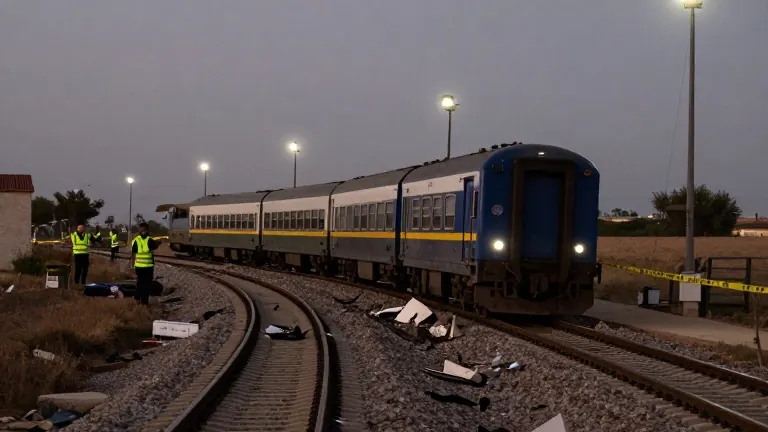
A Spanish train collision on Wednesday killed 69 people after a safety system went offline and a controller restarted one train while the other remained stationary.
Investigators said the incident began at 8:31 a.m. when the LZB system, which monitors train positions and can apply brakes automatically, failed. Because both trains were between two analogue sensors, a backup system did not engage. Traffic controllers at a Madrid post assumed responsibility for a 63-kilometer stretch of track, with two controllers monitoring the Madrid-Seville line. At 8:36, a controller authorized a state-owned RENFE train to resume normal speed while a privately operated IRYO train remained stopped 25 kilometers down the line. The trains collided at 8:53, moving between 160 and 200 kph.
Transport Minister Óscar Puente called the controller's decision to allow one train to restart while the other was stationary "inexplicable" and "erroneous" in the immediate aftermath of the crash. He told reporters on Friday that "the information points to a mistake in the control center." Puente said his ministry increased the number of train traffic controllers from 1,000 in 2016 to 1,700 now.
Railway unions disputed the focus on individual error. Raquel Ayllón, spokesperson for SCF, the railway traffic controllers union, told The Associated Press that workload regularly exceeds what current staff can safely handle. "We believe (the minister) is blaming a mere worker who was working under increasingly poor conditions," Ayllón said. "Human error isn't incomprehensible. What is incomprehensible is that the safety system is regularly failing." Diego Martín, spokesperson for the SEMAF train engineers union, said the LZB system "should have been replaced some time ago." Puente said the system has gone offline 170 times this year, which he called normal within recent averages.
Spain's high-speed rail network is the world's second-largest, after China's, and had not seen a fatal crash in the more than three decades since it entered service. This year's collision was the second on the Madrid-Seville line; a January crash killed 46 people and remains under investigation. Spain went from 35 million train travelers in 2019 to 49 million in 2024, according to the Spanish National Markets and Competition Commission. Spanish Prime Minister Pedro Sánchez said Friday from the crash site near Urda that "it is unacceptable that a country like Spain with such a strong high-speed railway has two accidents of this type in the same year."
Investigators removed the trains' black boxes late Thursday and gave them to the Civil Guard for inspection, and a judge is also investigating the crash. Seventy families have filed missing persons reports, five bodies have been identified, and 39 people remain hospitalized from the more than 200 injured.
Source: La Voz de Houston